
Background Owing to their estrogenic properties, isoflavones from soybean seeds are of great interest for human health. However, secondary effects are ambiguous and concerns among French consumers rise because of their unwanted exposure. The cotyledon and embryo axis have independent regulation of isoflavone accumulation and composition. Cotyledons are processed separately in the food sector. Breeders need high throughput cotyledons phenotyping tools for developing suitable cultivars. Near infrared spectroscopy is commonly employed as a fast and non-destructive tool to predict protein and fatty acid contents in soybeans.
Objectives: Predict isoflavones contents from soybean cotyledons with near infrared spectroscopy and compare performances between raw and transformed seeds
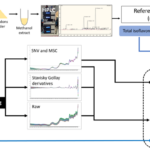
Methods Near-infrared spectra (3 replicates; reflectance mode; 800 – 2800 nm) were measured i) on whole seeds from 360 samples collected in different conditions (locations x years) in France; and ii) on grinded and unground cotyledons from 150 of these samples. The reference analysis was performed using HPLC on freeze dried and ground cotyledons extracted for 2 hours in 80% methanol / 20% water, the unit is expressed as aglycone equivalent by gram of dry weight .
Chemometric analysis was used to make the predictions from spectra: PCA and PLS regression models were built on mathematically preprocessed spectra (1st, 2nd, and 3rd Stavisky Golay derivatives, Standard Normal Variate associated with detrend transformation, Multiplicative Scatter Correction, and no preprocessing). Cross validation (CV) and external validation on 20% left samples (P) was performed for the PLS models. For ANN models, 68% of the data was used as a training set. With the remaining, 16% were used for validation and testing each. R² and error (RMSE) from predicted data are excellent performance indicators, yet RMSE by standard deviation (RPD) indicates the model’s applicability.
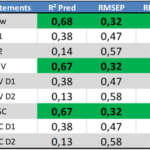
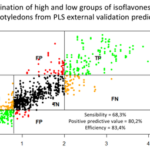
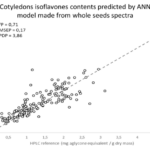
Results Among the different pretreatments tested, raw spectra SNV and MSC gave the best predictions. Derivative and detrend transformations on spectrum should be avoided. PLS regression bring promising models in external validation (R² around 0.67 and RMSEP at 0.32) but their RPD (1.77 maximum) was insufficient for quantitative application. However it allowed efficient qualitative screening for the extreme isoflavone contents. The best model developed by ANN were by using hyperbolic tangent as input and logistic function as output. The R² rised at 0.71 and the error dropped below 0,2 consistently. Thus, RDP of ANN prediction is very good and sufficient for process control. The predictions from entire seeds, whole cotyledons, and ground cotyledons were equivalent despite their distinct spectrum shapes. Daidzein and Genistein were both as well predicted than total isoflavones.
Conclusion: Using raw or SNV/MSC transformed spectra, chemiometric analysis can produce powerful estimations of isoflavone concentration from cotyledons, regardless of the matrice examined, and especially when employing ANN models.


0 Comments