
Genetic diversity in early maturity Chinese and European elite soybeans: A comparative analysis
Xindong Yao, Johann Vollmann, Leopold Rittler, Jiang-yuan Xu, Zhang-xiong Liu, Martin Pachner, Eva Maria Molin, Volker Hahn, Willmar Leiser, Yong-zhe Gu, Yu-qing Lu, Li-juan Qiu
10.01.2023
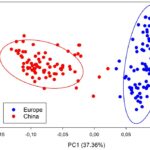
China is the motherland of soybean and the rich center of genetic diversity represented by numerous soybean landraces and other genetic resources. During the last 100 years, world-wide dissemination of Asian soybean introductions has laid the foundation of modern soybean production. As selection for regional adaptation might narrow the genetic base in modern cultivars, genetic diversity of early maturity Chinese and European elite soybeans was comparatively analyzed using different genetic marker systems (i.e. a high-throughput functional SNP array and a set of SSR markers). Results revealed a clear differentiation between Chinese and European elite cultivars. Surprisingly, the level of genetic diversity was similar between the two elite populations. Unique SSR alleles were found in both populations which indicates that selection for specific adaptation can preserve genetic variation. The clear difference between Chinese and European cultivars might partly be due to the fact that very early maturity and cold tolerant soybeans grown in central and northern regions of Europe are mainly tracing back to soybeans which were introduced to Sweden from the far-east Russian island of Sakhalin. While diversity of European and Chinese cultivars is on a similar level, structure analysis indicated that European cultivars are based on two major ancestors, whereas Chinese elite soybean cultivars trace back to more ancestral lines pointing to the rich natural soybean diversity of China with a much more diverse genetic background. The results also confirm that long-term selection under divergent environmental and agronomic conditions such as in China or Europe can produce specific diversity. As genetic diversity is the most important factor for breeding success, the genetic differences between modern Chinese and European cultivars could potentially be utilized for future enhancing both Chinese and European soybean breeding.
Downloads
About this article
Xindong Yao, Johann Vollmann, Leopold Rittler, Jiang-yuan Xu, Zhang-xiong Liu, Martin Pachner, Eva Maria Molin, Volker Hahn, Willmar Leiser, Yong-zhe Gu, Yu-qing Lu, Li-juan Qiu
The authors acknowledge the financial support from the National Key Research and Development Program of China (2019YFE0105900). Furthermore, we gratefully acknowledge the support provided by the Friedrich Haberlandt Scholarship committee, administrative support by Donau Soja, and financial support from German Federal States of Baden-Württemberg and Bavaria, the Swiss Confederation (Agroscope), and Saatgut Austria (Seed Association of Austria). The authors are also grateful to soybean breeding companies and institutions for providing seed of soybean cultivars used in the present research. Helpful personal advice provided by Mr. Matthias Krön (Vienna, Austria) and Dr. Donal Murphy-Bokern (Lohne, Germany) is also gratefully acknowledged. Open access funding of the publication is provided by University of Natural Resources and Life Sciences, Vienna (BOKU), Vienna, Austria.
For matters related to publisher, citation and copyright, please refer to the original article.
The content is solely the responsibility of the authors. No warranties, expressed or implied, are made with respect to the information provided. Information relating to the use of plant protection products (pesticides) must be checked against the product label or other sources of product registration information.
0 Comments